
You tap your card in a shop abroad and the screen asks a simple-looking question: pay in the local currency or in your home currency? That offer is called dynamic currency conversion (DCC), and the “friendly” home-currency option often costs more.
This guide explains what DCC is, where it shows up, what the rules say, and how to answer the question in two seconds. It’s general consumer information, not financial advice. Rules quoted cover the EU, Visa’s network rules and Australia’s consumer regulator (ACCC); check your own card’s terms too.
The Quick Answer
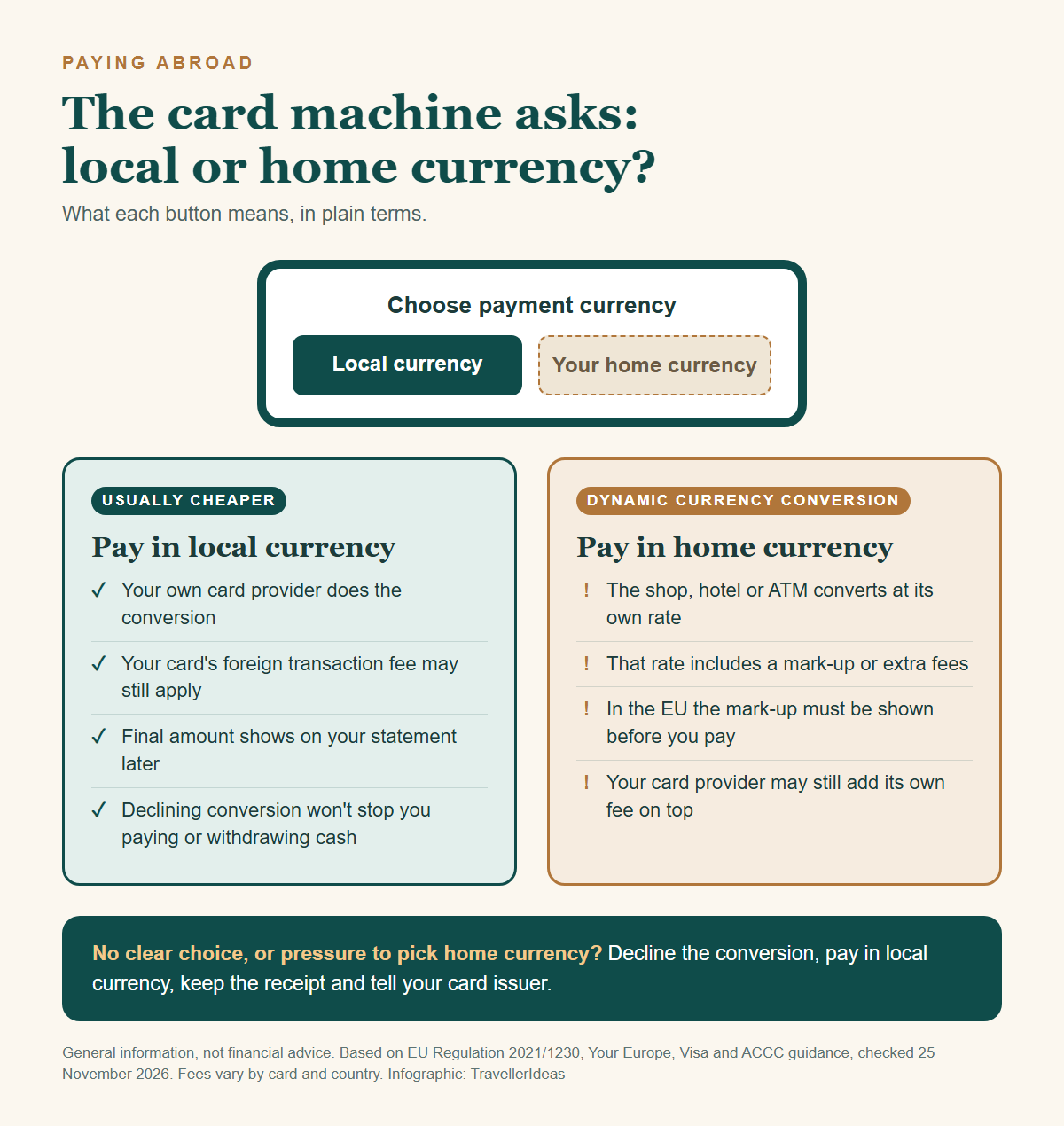
When a card machine, hotel, website or ATM abroad offers to charge you in your home currency, it is offering dynamic currency conversion: the merchant’s side converts the price at its own rate, which includes a mark-up or extra fees. Choosing the local currency is often the cheaper option, because your own card provider then does the conversion. Your card’s foreign transaction fee can still apply either way, so check your card terms before you travel.
On this page
- What is dynamic currency conversion?
- Where you’ll be offered it
- Local currency vs home currency: what changes
- What the rules say
- How to avoid dynamic currency conversion
- If you were charged in your home currency anyway
- Dynamic currency conversion FAQ
- The Bottom Line
What is dynamic currency conversion?
Dynamic currency conversion is an optional service where the business you’re paying (or the ATM you’re using) converts the amount into your card’s home currency on the spot. You see a familiar number, such as dollars or pounds, instead of euros, baht or dirhams.
The catch is the rate. Visa explains that the home-currency option “includes exchange rate and additional fees”, set by the merchant’s provider rather than your bank. If you choose the local currency instead, the merchant is paid in its own currency and your card provider converts it later.
💡 GOOD TO KNOW
Paying in your home currency does not necessarily switch off your own bank’s fee. Australia’s consumer regulator notes that a card issuer may still charge an international transaction fee even when you pay in Australian dollars, because the transaction happened overseas. So DCC can mean paying a mark-up and a card fee.
Source: ACCC, Foreign currency and money exchange, checked 25 November 2026
Where you’ll be offered it
DCC isn’t limited to one type of shop. Expect the question in places like these:
- Card machines in shops, restaurants and attractions, often as two buttons on the screen.
- Hotel checkout, where staff may ask “would you like to pay in your own currency?” before running the card.
- ATMs abroad, which may offer to bill your withdrawal in your home currency at a quoted rate.
- Online checkouts on foreign websites, which can show a price converted into your currency.

Local currency vs home currency: what changes
| Pay in local currency | Pay in home currency (DCC) | |
|---|---|---|
| Who converts the money | Your card provider | The merchant’s or ATM operator’s provider |
| Exchange rate used | Your card network’s or bank’s rate | A rate set by the DCC provider, including a mark-up or fees |
| Your card’s foreign fee | May apply (check your terms) | May still apply, depending on your card |
| When you know the final amount | On your statement | At the till, on screen and receipt |
| What official guidance says | “Often the cheapest option” (Your Europe) | “The extra fees often make this option more expensive” (Your Europe) |
The one real benefit of DCC is certainty: you know the exact charge in your home currency straight away. For most travellers, that certainty isn’t worth paying extra for.
What the rules say
In the EU
EU law is the most detailed on this. Under Regulation (EU) 2021/1230, a business or ATM offering conversion must:
- express the total conversion charges as a percentage mark-up over the latest European Central Bank (ECB) euro reference rate, and show it before you pay;
- show both the amount the merchant receives in its currency and the amount you’ll pay in your account’s currency;
- tell you that you can pay in the merchant’s currency and let your own card provider convert it;
- give you the same information on a durable medium (such as a receipt) after the payment.
The European Commission’s Your Europe guidance puts it simply: if a trader offers your home currency, they must tell you exactly how much extra it will cost.
💡 GOOD TO KNOW
EU card providers must also send you an electronic message (for example by app or email) after you pay or withdraw cash in an EU currency that differs from your account’s currency. It shows the conversion charges as a mark-up over the ECB rate, arrives once in each month you pay in that currency, and you can opt out.
Source: Regulation (EU) 2021/1230, Article 4, checked 25 November 2026
On the Visa network
Outside the EU, card network rules still apply. Visa requires merchants and ATMs to show the amount in both currencies, the exchange rate and any fees or mark-up on the screen and receipt. It says they must give you the choice and must not choose on your behalf, and shouldn’t steer you with tricks like different font sizes or colours.
💡 GOOD TO KNOW
If the required details are missing or you feel pressured, Visa recommends declining the currency conversion offer and reporting the incident to your card issuer. Visa also says that accepting or declining DCC won’t affect your ability to make purchases or withdraw cash internationally.
Source: Visa, Dynamic Currency Conversion, checked 25 November 2026
How to avoid dynamic currency conversion
- Decide before you travel: your default answer is “local currency, please”.
- Read the screen before tapping or entering your PIN. Look for the currency symbol on the amount, not just the bigger button.
- Say it out loud when staff hold the card machine: ask to be charged in the local currency.
- At ATMs, decline the conversion when it’s offered, then check the withdrawal amount and any operator fee shown.
- Check the receipt. If it shows your home currency when you asked for local, raise it on the spot.
- Know your card’s own fee. Our guide to avoiding foreign transaction fees explains what your card provider may add.
Choosing the right card matters too. If you’re still deciding what to pack in your wallet, compare the options in card, cash or travel card, and see our travel money tips for the full before-you-go routine. Your card plan belongs on the money line of our international travel checklist.
If you were charged in your home currency anyway
It happens: a rushed checkout, a pre-selected option, a receipt you only read later. Here’s a calm sequence:
- Keep the receipt and photograph it, including the exchange rate and mark-up lines.
- Note the date, time and merchant name while you still remember them.
- Contact your card issuer and explain that you weren’t given a clear choice or asked for local currency. Visa’s guidance is to report the incident to your issuer.
- In the EU, compare the mark-up on the receipt with the electronic message your card provider sends afterwards.
Outcomes depend on your issuer and the circumstances, so don’t assume a refund. The earlier you report it, the easier it is to look into.
Plan Your Next Trip
Get the rest of your travel money set up before you fly.
Dynamic currency conversion FAQ
What is dynamic currency conversion?
Dynamic currency conversion is an offer to pay abroad in your home currency instead of the local one. The merchant’s or ATM operator’s provider converts the amount at its own rate, which includes a mark-up or extra fees, so you see the final home-currency figure at the till.
Should I pay in local currency or my home currency abroad?
In most cases, pay in the local currency. EU guidance describes paying in local currency as often the cheapest option and warns that the extra fees often make the home-currency option more expensive. Check your own card’s foreign transaction fee, which may apply either way.
Is dynamic currency conversion a scam?
No, it’s a legal, optional service, but it is usually the more expensive choice. Card network rules such as Visa’s require merchants to show the rate and fees and let you choose. Being charged in your home currency without a clear choice is something to report to your card issuer.
Does paying in my home currency avoid foreign transaction fees?
Not necessarily. Australia’s ACCC notes a card issuer may still charge an international transaction fee when you pay in your home currency, because the transaction took place overseas. You could end up paying both a conversion mark-up and your card’s fee.
Do ATMs abroad use dynamic currency conversion?
Yes, some do. An ATM may offer to bill your withdrawal in your home currency at a quoted rate. Declining the conversion means your own card provider converts it instead; the ATM operator’s own withdrawal fee, if any, is a separate charge.
What should I do if I was charged in my home currency without being asked?
Keep the receipt and contact your card issuer as soon as you can. Visa recommends declining the offer when details are missing or you feel pressured, and reporting the incident to your card issuer.
The Bottom Line
Dynamic currency conversion trades a familiar number for a worse deal in most cases. Make “local currency, please” your default answer at card machines, hotel desks, ATMs and foreign checkouts, read the screen before you confirm, and report it to your card issuer if the choice was made for you.
Last updated: 25 November 2026. Fees, network rules and regulations change, and charges vary by card and country. This is general information, not financial advice; confirm with the official sources linked above and your card provider’s current terms.