Card, cash or a prepaid travel card? There isn’t one winner. The best way to pay when traveling abroad is usually a mix: a card for most spending, a second card as backup, and a little local cash for the places cards don’t reach.
This guide compares the options on cost, safety and acceptance, so you can build the right combination for your trip. It’s general consumer information, not financial advice, and it doesn’t rank specific cards or providers. Fraud-protection figures refer to US federal rules; currency-conversion rules refer to the EU. Check your own card’s terms and your country’s consumer rules.
The Quick Answer
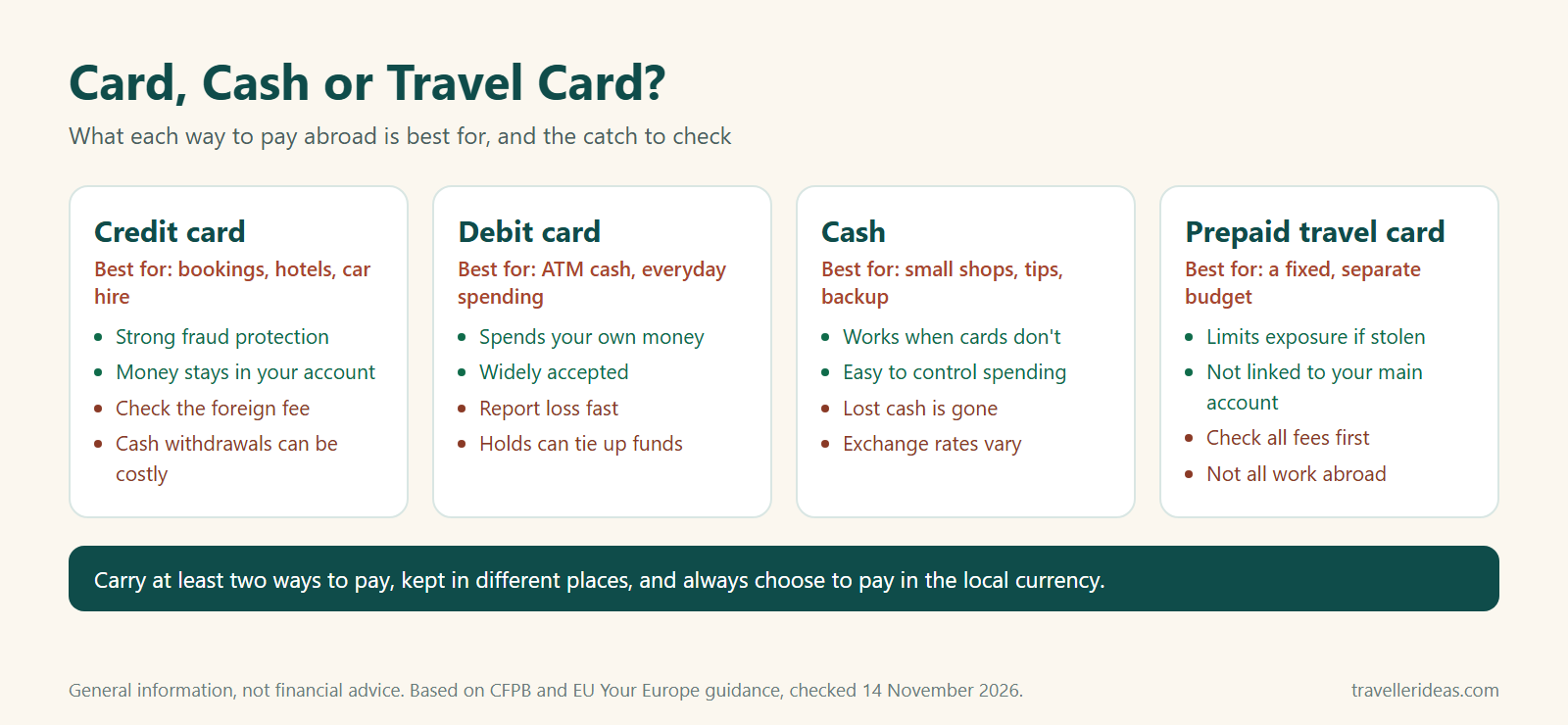
For most trips, pay by card for the bulk of your spending (a credit card generally gives the strongest fraud protection), use a debit card for occasional cash withdrawals, and carry a small amount of local cash as backup. Check each card’s foreign transaction and ATM fees before you go, always choose to pay in the local currency, and keep two payment methods in different places. Prepaid travel cards suit people who want a fixed, separate budget, but compare their fees carefully.
On this page
- Card vs cash vs travel card: comparison
- Credit cards abroad
- Debit cards abroad
- Cash: how much and when
- Prepaid travel cards
- Always pay in the local currency
- The best way to pay when traveling abroad: a simple setup
- Paying abroad FAQ
- The bottom line
Card vs cash vs travel card: comparison
| Option | Cost to check | Safety | Acceptance | Best for |
|---|---|---|---|---|
| Credit card | Foreign transaction fee; cash advance fees and interest on ATM use | Strong: US liability for unauthorised charges capped at $50 | Wide, especially Visa and Mastercard | Hotels, car hire, bookings, larger purchases |
| Debit card | Foreign transaction fee; your bank’s and the ATM operator’s withdrawal fees | Good if reported fast; protection drops the longer you wait (US) | Wide; best for ATMs | Cash withdrawals, everyday spending |
| Cash | Exchange rate and any commission when you buy it | Weak: lost or stolen cash is usually gone | Near-universal, but some places are card-only | Small shops, markets, tips, backup |
| Prepaid travel card | Load, conversion, ATM and inactivity fees vary by issuer | Limits exposure because it’s separate from your main account | Varies; not all cards work abroad | A fixed, separate travel budget |
Fees and protections differ by card and country. Check your issuer’s fee schedule and terms before you travel.
Credit cards abroad
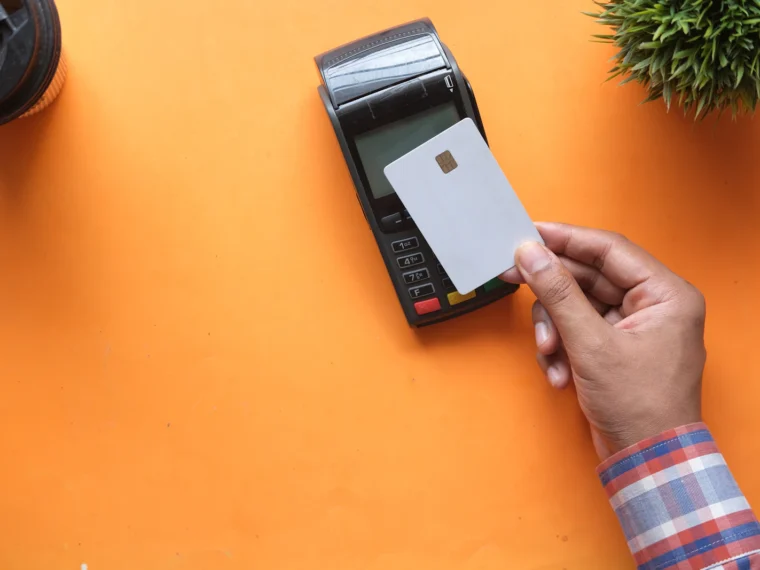
A credit card is often the most practical way to pay for big-ticket items abroad. Hotels and car rental desks commonly take a card for deposits, and because you’re spending the bank’s money first, a fraudulent charge doesn’t empty your current account while it’s investigated.
📊 TRAVEL INSIGHT
Under US federal rules, the most you owe for unauthorised charges on a lost or stolen credit card is $50, and many card agreements set it at $0. For a lost or stolen debit card, liability is capped at $50 only if you report it within two business days; after that it can rise to $500, and beyond 60 days after your statement you could lose more.
Source: CFPB, credit card liability and CFPB, unauthorised bank account transactions, checked 14 November 2026
The catch: foreign transaction fees on some cards, and cash withdrawals, which many credit cards treat as a cash advance, often with extra fees and interest. Use a credit card to pay, not to withdraw cash, unless you’ve checked the terms.
Debit cards abroad
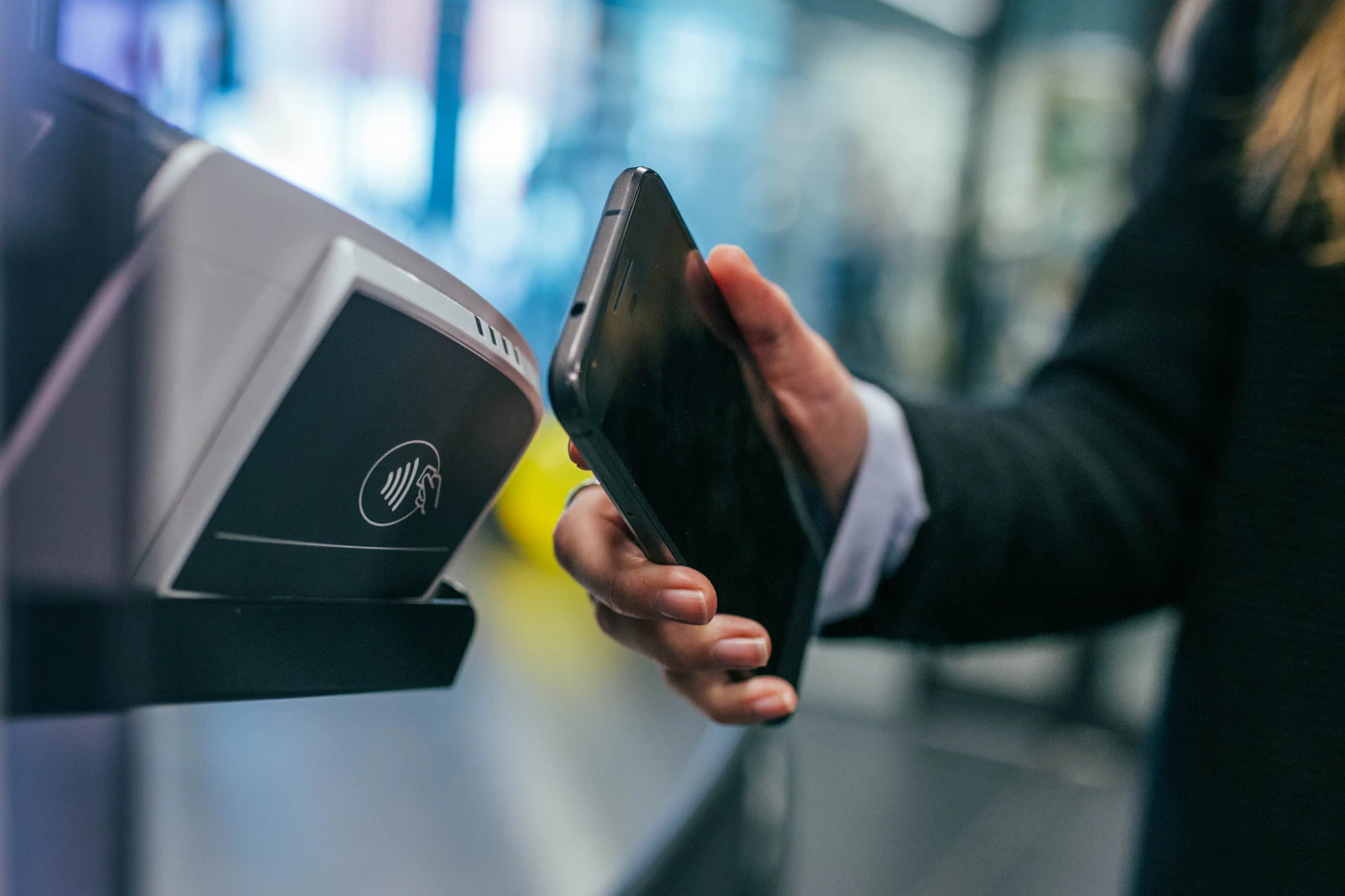
A debit card is usually the simplest way to get local cash from an ATM, and it spends your own money, so there’s no bill to pay later. The trade-offs are fees and exposure: you may pay your bank’s foreign fee plus the ATM operator’s charge, and if the card is skimmed, the money leaves your account straight away.
- Withdraw less often, in larger amounts, to limit per-withdrawal fees.
- Use ATMs at banks, ideally inside, rather than standalone machines.
- Report a lost card immediately in your banking app; speed matters for your protection.
- Consider a separate account with only your travel money in it.
💡 GOOD TO KNOW
If your account is in euro, EU rules say your bank must charge you the same for euro payments and euro ATM withdrawals anywhere in the EU as it does at home. Traders and banks also can’t add a surcharge for using a particular consumer card in the EU, though three-party cards like American Express and business cards are excluded.
Source: EU Your Europe, payments and transfers, checked 14 November 2026
Cash: how much and when
Cards are everywhere, but cash hasn’t disappeared. In the euro area, the European Central Bank found that 52% of point-of-sale payments were made in cash in 2024, even though cards made up the largest share by value. Small cafés, markets, taxis and tips are where cash still helps most.
Carry enough for a day or two plus an emergency reserve, split between your wallet and a separate hiding place. Our travel money tips guide covers how much cash to carry, customs limits and avoiding ATM fees in more detail. Source for the cash figure: ECB, SPACE 2024, checked 14 November 2026.

Prepaid travel cards
A prepaid travel card is loaded with money in advance and isn’t linked to your main bank account, which limits the damage if it’s lost or skimmed. It can also help you stick to a budget. But the US Consumer Financial Protection Bureau notes that not all prepaid cards can be used outside the US and some charge foreign transaction fees, so read the cardholder agreement first.
Before choosing one, check the fees for loading, currency conversion, ATM withdrawals abroad, inactivity, and cashing out any leftover balance.
Always pay in the local currency
Whatever you use, you’ll often be asked whether to pay in your home currency or the local one. This offer, called dynamic currency conversion, usually comes with a worse exchange rate. Choosing the local currency lets your card provider do the conversion instead.
💡 GOOD TO KNOW
In the EU, if a shop or website offers to charge you in your home currency, it must tell you exactly how much extra that costs, shown as a percentage mark-up over the latest European Central Bank exchange rates. You always have the right to say no and pay in the local currency.
Source: EU Your Europe, pricing and payments, checked 14 November 2026
The best way to pay when traveling abroad: a simple setup
- Main card for most spending, ideally with no or low foreign transaction fees.
- Backup card from a different account and, if possible, a different network, kept separately.
- Debit card for occasional ATM withdrawals (this can be your backup).
- Small amount of local cash for arrival, tips and card-free places.
- Banking apps set up so you can freeze a card and check spending on the go.
Building a full trip budget? Our budget travel planning guide helps you set daily spending, and the international travel checklist covers money alongside documents, packing and safety.
Plan Your Next Trip
Sort the rest of your travel money and prep:
Paying abroad FAQ
What is the best way to pay when traveling abroad?
For most trips, a mix works best: a card for most spending, a backup card kept separately, and a small amount of local cash. Check each card’s foreign transaction and ATM fees before you go, and always choose to pay in the local currency.
Is it better to use a credit card or debit card abroad?
A credit card is usually better for purchases because it typically offers stronger fraud protection and doesn’t draw on your own money. A debit card is usually better for ATM cash, since credit card cash withdrawals often count as cash advances with extra costs.
Should I take cash when travelling abroad?
Yes, a small amount is wise for arrival, tips, small shops and as a backup if a card fails. Cash is still widely used in many places; the ECB found 52% of point-of-sale payments in the euro area were in cash in 2024.
Are prepaid travel cards worth it?
They can be if you want a fixed, separate budget that isn’t linked to your main account. Compare fees for loading, conversion, ATM use and inactivity, and confirm the card works in your destination before relying on it.
Should I pay in local currency or my home currency abroad?
Usually the local currency. Paying in your home currency (dynamic currency conversion) often comes with a worse exchange rate, and in the EU you have the right to refuse it and pay in the local currency.
What happens if my card is stolen abroad?
Freeze or cancel it in your banking app straight away and switch to your backup. Under US rules, reporting a lost debit card within two business days keeps your liability to $50 at most, while credit card liability is capped at $50.
The Bottom Line
Don’t rely on one way to pay. A card for most spending, a backup card kept separately, a debit card for cash and a small amount of local currency covers almost every situation. Check fees before you go and always choose the local currency at the till or ATM.
Last updated: 14 November 2026. This is general information, not financial advice. Fees and consumer protections vary by card, provider and country, so confirm the details with your card issuer and the official sources linked above before you travel.