
Most trip problems that can’t be fixed at the airport start weeks earlier: a passport that runs out too soon, a missing electronic travel authorisation, a vaccine appointment booked too late. This international travel checklist puts the jobs in the order to do them, from documents and health to money, packing and safety, with links to the official sources that actually set the rules.
Rules depend on your passport, your destination and your airline, so treat this as the framework and the linked official pages as the final word. All sources were checked on 5 November 2026. For destination-specific advice, see guides such as our Dubai travel guide.
The Quick Answer
Two to three months out, check your passport validity, visa or eTA rules, travel vaccines and insurance. A month out, read your government’s travel advice and sort out cards and a backup way to pay. In the final week, back up your documents, register your trip if you can and save emergency contacts. The day before, pack liquids and batteries to the rules and check in.
On this page
- Your international travel checklist at a glance
- Documents and entry rules
- Health and travel insurance
- Money: cards, cash and a backup plan
- Packing: what goes in which bag
- Safety and emergency contacts
- The last 24 hours before you fly
- International travel checklist FAQs
- The bottom line
Your international travel checklist at a glance
The trick is timing. Some tasks (passport renewals, visas, vaccines) need weeks of lead time; others only make sense the day before. Print or screenshot the version below, then use the sections that follow for the detail.
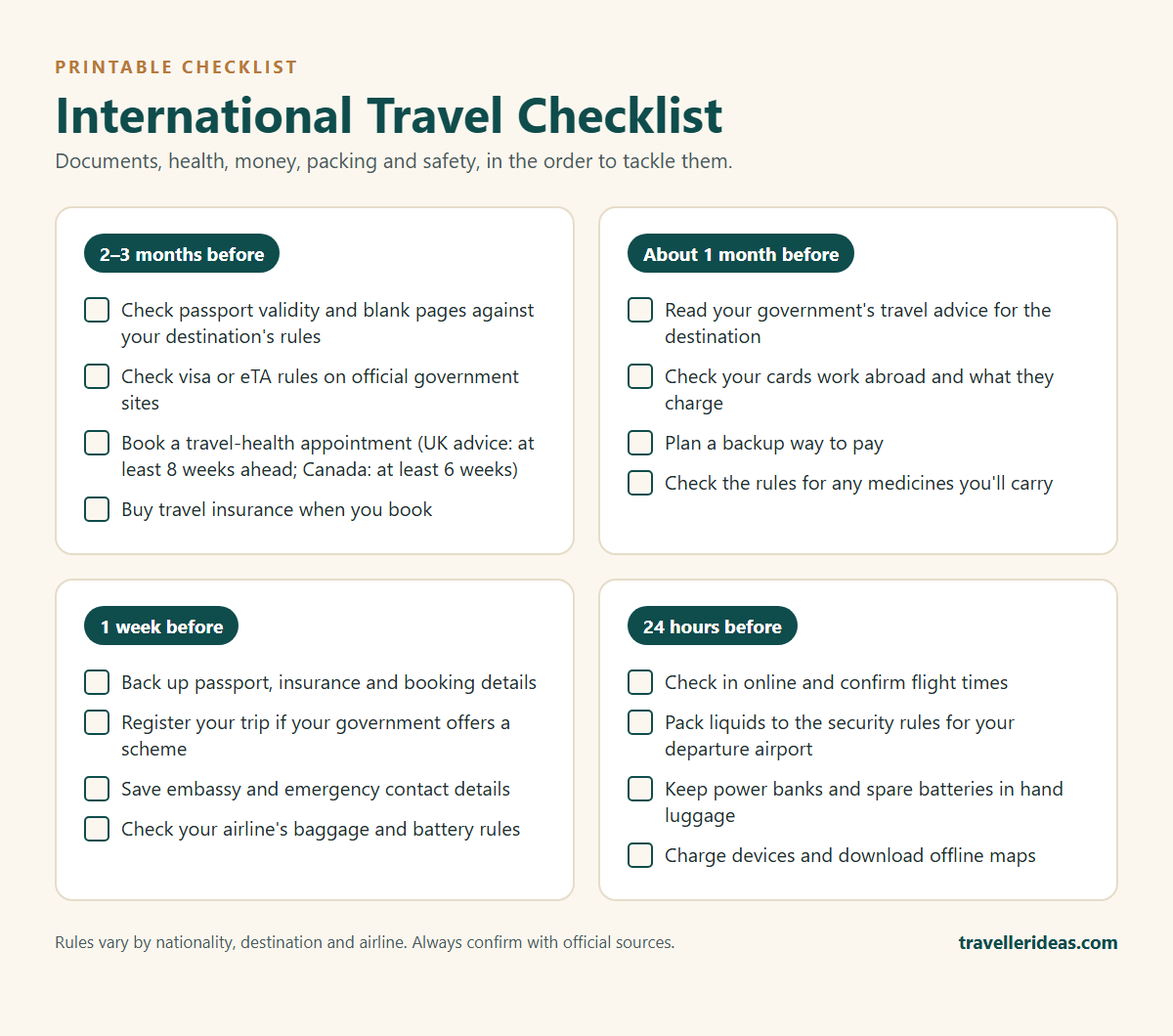
| When | Main jobs | Why it can’t wait |
|---|---|---|
| 2–3 months before | Passport validity, visa or eTA rules, travel-health appointment, travel insurance | Renewals, applications and some vaccine courses take time |
| About 1 month before | Government travel advice, cards and fees, backup payment, medicine rules | Gives you time to change plans or order what’s missing |
| 1 week before | Document backups, trip registration, emergency contacts, airline baggage rules | Everything is booked, so details are final |
| 24 hours before | Check-in, liquids, batteries, charged devices, offline maps | Last chance to fix small problems at home |
Documents and entry rules
Documents go first because they’re the only part of the checklist that can stop you boarding. If something is wrong here, no amount of packing or budgeting will rescue the trip.
Check passport validity first
Your passport may need to be valid for a set period after your trip ends, not just on the day you land. The UK government’s foreign travel checklist flags this, and the exact rule is set by each destination.
One example: for short stays in the Schengen area, the EU’s Your Europe guidance for non-EU nationals says your passport must have been issued within the last 10 years and be valid for at least 3 months after the date you plan to leave. Other countries set different rules, so check each one on your route.
💡 GOOD TO KNOW
An in-date passport can still fail the Schengen rule. If it was issued more than 10 years before the day you enter, it doesn’t qualify, even if the expiry date is still in the future. Check the issue date as well as the expiry date.
Source: Your Europe (European Union), checked 5 November 2026
Visas, eTAs and layovers
Whether you need a visa, an electronic travel authorisation (eTA) or nothing at all depends on your nationality, your residence status and the purpose of your trip. The Government of Canada’s traveller’s checklist advises checking early and applying well in advance if you need one.
- Start with your own government’s travel advice for the destination, for example GOV.UK foreign travel advice, which includes entry requirements by country.
- Then confirm on the destination’s own official immigration or visa portal.
- Check any country where you change planes too. A layover can come with its own requirements.
- Be wary of look-alike visa websites. Search results can include private agents that add their own fees, so reach the application page through the government’s own website.
Our visa and entry guides will go deeper into individual schemes as they’re published.
Copies, backups and spare ID
- Sign your passport and fill in its emergency contact page, as GOV.UK recommends.
- Carry a second form of photo ID as well as your passport.
- Keep a secure backup of the essentials: passport details, accommodation, flights, insurance and key phone numbers, in case you lose your phone.
- Leave your itinerary and copies of your passport photo page and insurance policy with someone at home, as Canada’s checklist suggests.
Health and travel insurance
Book the health appointment early. GOV.UK says to check vaccinations and health precautions at least 8 weeks before you travel; the Canadian checklist says to see a travel health clinic or provider at least 6 weeks before. Either way, two weeks out is late.
- Check the health advice for every country you’ll visit, not just the main one.
- Check the rules for taking your medicines into each country, including whether you need a prescription or doctor’s letter.
- Buy travel insurance as soon as you book, so cancellation cover starts early. Check it covers your destinations, trip length and activities.
- Declare medical conditions to your insurer, including ones still being investigated, and confirm they’re covered.
Canada’s checklist recommends insurance “even if it’s for a short trip across the border.” That’s a fair rule of thumb wherever you’re from.
💡 GOOD TO KNOW
Travelling from the UK to the EU or Switzerland? A GHIC or EHIC is not travel insurance. GOV.UK says it may not cover all health costs and never covers repatriation, so you still need a policy.
Source: GOV.UK foreign travel checklist, checked 5 November 2026
This is general information, not medical advice. Talk to a doctor, pharmacist or travel clinic about vaccines and medicines for your own trip.
Money: cards, cash and a backup plan
The goal isn’t the perfect card. It’s making sure you can still pay if one method fails.
💡 GOOD TO KNOW
Many banking apps and card payments rely on your phone for two-factor authentication. GOV.UK’s checklist specifically warns about losing your phone and being unable to complete it, so keep at least one way to pay that doesn’t depend on that single device.
Source: GOV.UK foreign travel checklist, checked 5 November 2026
- Check with your bank or card issuer that your cards work abroad and what they charge for foreign spending and cash withdrawals.
- Carry at least two ways to pay and keep them in different places.
- Make sure you can reach enough money for unexpected costs, such as a missed connection or an extra hotel night.
- If a card machine or ATM offers to charge you in your home currency, the conversion is done by that machine’s provider rather than your card issuer. Compare before you accept.
For the bigger picture of what the trip will cost, see our guide to budget travel planning. More detail on fees, cash and exchange rates will sit in our travel money and budget guides. This is general consumer information, not financial advice.
Packing: what goes in which bag
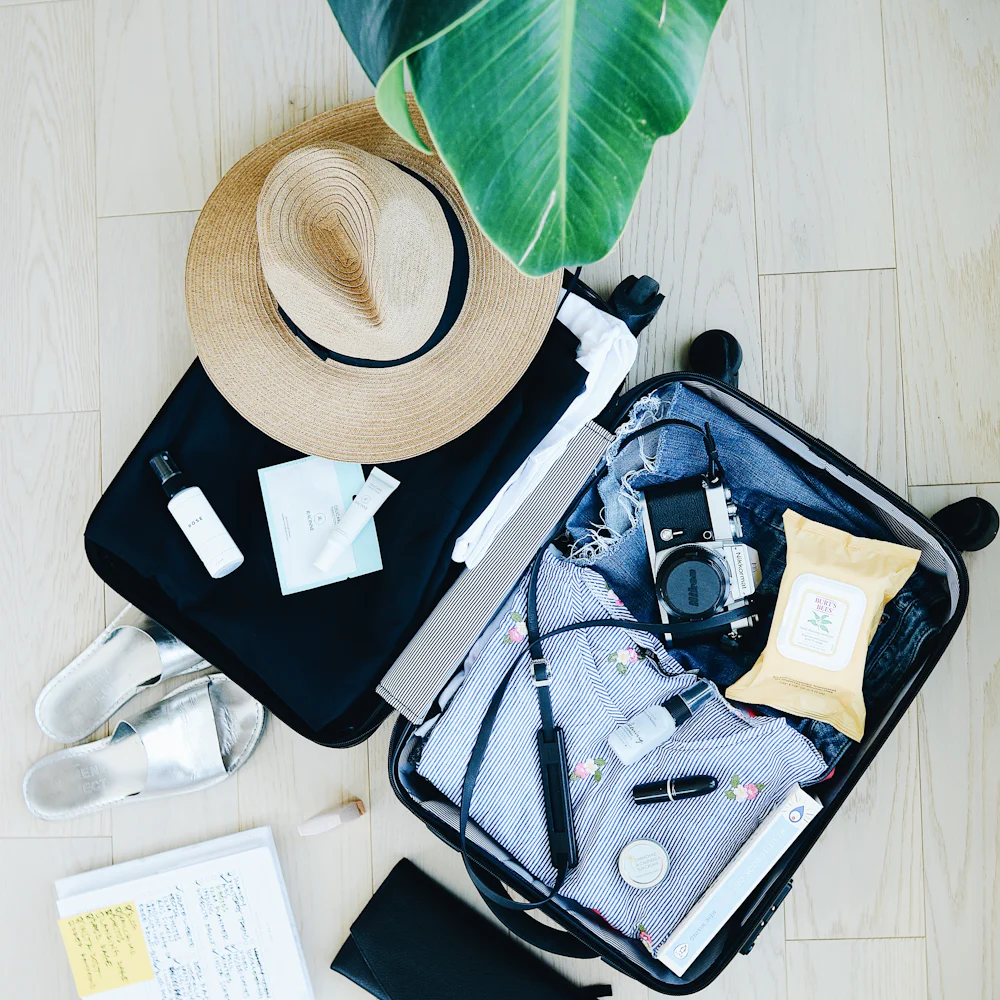
What you pack matters less than where you pack it. Two rules catch out the most travellers: liquids and lithium batteries. The table uses US rules as a worked example because they’re clearly published; other countries’ security rules can differ, and airlines can be stricter.
| Item | Where it goes | Source |
|---|---|---|
| Liquids, gels and creams of 100 ml (3.4 oz) or less | Hand luggage, in one quart-sized bag | TSA (US screening) |
| Liquids over 100 ml | Checked bag (medication and infant food have exemptions) | TSA (US screening) |
| Power banks and spare lithium batteries | Hand luggage only; take them out if your bag is checked at the gate | FAA PackSafe |
| Spare lithium-ion batteries of 101–160 Wh | Hand luggage, with airline approval, maximum two per person | FAA PackSafe |
| Passport, medicines, valuables | On you or in hand luggage | Our suggestion, so they don’t get lost with a checked bag |
📊 TRAVEL INSIGHT
The FAA has verified 83 lithium battery incidents involving smoke, fire or extreme heat on aircraft in 2026 so far (to 2 November), and 800 since March 2006. Battery packs and loose batteries are the biggest single category, at 322. The FAA notes its list isn’t complete. It’s the reason power banks travel in the cabin, where crew can deal with them quickly.
Source: FAA lithium battery incidents, checked 5 November 2026
The FAA also notes that many airlines set stricter limits on how many power banks you can bring. Our packing guides will cover full packing lists and cabin rules in more detail.
Safety and emergency contacts
Government travel advice is the best free safety briefing you’ll get. Canada’s checklist suggests reading it for the destination’s risk level, safety, entry rules, health, local laws and climate.
- Read the advice from your own government for each country on the trip.
- Register your trip if your government offers a scheme. Canada’s Registration of Canadians Abroad lets the government contact you in an emergency, such as a natural disaster or civil unrest.
- Save embassy details. Note how to reach your nearest embassy or consulate. British nationals can call the FCDO in London 24 hours a day on 020 7008 5000, per GOV.UK.
- Share your plans with someone at home and agree when you’ll check in.
- Think about your accommodation. GOV.UK’s checklist also covers accommodation safety, the signs of carbon monoxide poisoning and the risk of spiked drinks.
Find more practical advice in our travel safety guides.
The last 24 hours before you fly
- Check in online and confirm departure times and terminal.
- Put passport, visa or eTA confirmation, insurance details and bookings where you can reach them.
- Repack liquids to the rules for your departure airport and move power banks into your hand luggage.
- Charge your phone and power bank, and download offline maps and your booking confirmations.
- Do a final home check: windows, appliances, mail and who has a spare key.
Find all our checklists and how-tos in Travel Tips.
Plan Your Next Trip
Checklist sorted? Work out what the trip will cost, then dig into the details for your documents, bags and safety.
International travel checklist FAQs
When should I check my passport before travelling abroad?
As soon as you start planning, ideally 2–3 months before you go. Some destinations require your passport to stay valid for a set period after your trip ends; for short Schengen stays, for example, it must have been issued within the last 10 years and be valid for at least 3 months after you leave. Check the rule for each country on your route.
How far in advance should I see a doctor before international travel?
Aim for at least 6–8 weeks before departure. GOV.UK says to check vaccinations and health precautions at least 8 weeks before you travel, and Canada’s checklist says at least 6 weeks. If your trip is sooner, it is still worth booking an appointment.
Can I pack a power bank in checked luggage?
No, not under US FAA rules. The FAA says spare lithium batteries, including power banks, must go in carry-on baggage only, and many airlines set stricter limits, so check your airline before you fly.
Do I need travel insurance for an international trip?
It is strongly recommended even when it is not compulsory. Both the UK and Canadian governments advise buying it, and Canada’s checklist recommends it even for a short trip across the border. Check that the policy covers your destinations, activities and any medical conditions.
What documents should I carry when travelling internationally?
Carry your passport, any visa or eTA confirmation, a second form of photo ID, your insurance details and your bookings. Keep a secure backup copy of the key details, and leave copies with someone at home in case anything is lost.
The Bottom Line
Most of an international travel checklist is about timing. Get the slow jobs (passport, entry permission, vaccines, insurance) moving early, keep a backup for your money and your documents, and leave the packing rules for the final day. When in doubt, the official source for your passport and destination beats any checklist, this one included.
Last updated: 5 November 2026. Entry, health and baggage rules change often; confirm with the official sources linked above and with your airline before you travel.