

A passport that’s still in date can still get you turned away at check-in. Many countries have passport validity requirements that go beyond the expiry date: some want months of validity left after you arrive or leave, some look at the issue date, and some need blank pages for stamps.
This guide explains the main rule types, shows real examples, and gives you a simple method to check your own passport. The country examples are for British passport holders (from GOV.UK), plus the EU’s general rule for non-EU nationals. If you hold another passport, use the same method with your own government’s travel advice.
The Quick Answer
There’s no single worldwide rule. Some countries require your passport to be valid for 6 months after you arrive (the “6-month rule”), the Schengen area wants 3 months after you leave and an issue date within the last 10 years, and others only need it valid for your stay. Some also require 1 or 2 blank pages. Check the official entry requirements for every country on your route, including transit stops, and renew early if you’re close to any limit.
On this page
- The main types of passport validity requirements
- The 6-month rule explained
- Schengen: the 3-month and 10-year rules
- Examples by country
- Blank pages
- How to check your passport, step by step
- Passport validity FAQ
- The bottom line
The main types of passport validity requirements
Almost every rule you’ll meet is one of these, or a combination:
- Valid for the length of your stay. The passport just needs to last until you leave.
- Extra months after arrival. Often 6 months, counted from the day you enter.
- Extra time after departure. For example 3 months, or 30 days, after the day you leave.
- Issue-date limits. The passport must have been issued within a set number of years.
- Blank pages. A minimum number of empty pages for entry stamps or visas.
The key detail is what the count starts from: arrival, departure, or the end of your stay. Misreading that is one of the easiest ways to get caught out. Passport validity is one part of the wider entry check covered in our guide to checking whether you need a visa.

The 6-month rule explained
The “6-month rule” means your passport must still have at least six months left before it expires, usually counted from the day you arrive. If you land on 1 March, the passport typically needs to be valid until at least 1 September.
For British passport holders, GOV.UK lists this rule for destinations including the UAE and Thailand. It isn’t universal, though: the same source says a British passport only needs to be valid for the length of the stay in the USA and Japan. Rules can also differ by nationality, so a requirement that applies to one passport may not apply to another.
💡 GOOD TO KNOW
Transit can have its own rule. For British passport holders, GOV.UK says the UAE needs 6 months of validity on arrival, but only 3 months if you’re transiting without passing through immigration, or if you hold a UAE residence permit. Check every stop, not just your final destination.
Source: GOV.UK, UAE entry requirements, checked 14 November 2026
Schengen: the 3-month and 10-year rules
For non-EU nationals, the EU’s official Your Europe portal sets out two separate tests. Your passport should be:
- Valid for at least 3 months after the date you intend to leave the EU, and
- Issued within the last 10 years.
Both must be true on the day you enter. So a passport issued 9 years and 11 months ago can fail the second test on a two-week trip, even with plenty of time before its expiry date.
💡 GOOD TO KNOW
GOV.UK warns that if you renewed a British passport before 1 October 2018, it might have a date of issue more than 10 years ago, which could make it invalid for Schengen entry even though it hasn’t expired. Look at the issue date printed in the passport, not just the expiry date.
Source: GOV.UK, Spain entry requirements, checked 14 November 2026
Examples by country
These examples show how much the rules vary. They apply to British passport holders and come from GOV.UK’s entry requirements pages, checked 14 November 2026. Other nationalities may face different rules.
| Destination | Passport validity rule | Blank pages |
|---|---|---|
| Schengen area (e.g. Spain) | Issued less than 10 years before arrival; expiry at least 3 months after you leave | Not stated on the GOV.UK page |
| UAE | Expiry at least 6 months after arrival (3 months for residence permit holders or airside transit) | Not stated on the GOV.UK page |
| Thailand | Expiry at least 6 months after arrival | At least 1 |
| South Africa | Expiry at least 30 days after you leave | At least 2 |
| USA | Valid for the length of your planned stay | Not stated on the GOV.UK page |
| Japan | Valid for the length of your stay; no extra period required | Not stated on the GOV.UK page |
Sources: GOV.UK entry requirements for Spain, UAE, Thailand, South Africa, USA and Japan. Rules change, so always check the current page before you book.
Blank pages
Blank-page rules are easy to forget if you travel a lot. As the table shows, GOV.UK says South Africa requires at least 2 blank pages and Thailand at least 1 for British passport holders. If your passport is filling up, count the empty pages left and renew before a trip that needs them.

Your airline will usually check this before you fly, because airlines can face costs, including flying you home, if a passenger is refused entry.
📊 TRAVEL INSIGHT
Airlines check passports against IATA’s Timatic database, which IATA says is used to check the travel documents of over 700 million passengers a year. That’s why a validity problem is often caught at check-in, before you ever reach border control.
Source: IATA, Timatic, checked 14 November 2026
How to check your passport, step by step
- List every country on your route, including airports where you change planes.
- Open your own government’s entry requirements page for each one (for UK passports, GOV.UK foreign travel advice; for others, your foreign ministry’s equivalent).
- Note what each count starts from: arrival, departure or the end of your stay.
- Check both dates in your passport: the issue date and the expiry date.
- Count your blank pages if any country on the route asks for them.
- Confirm with your airline or travel provider, as GOV.UK advises, and renew if you’re close to any limit.
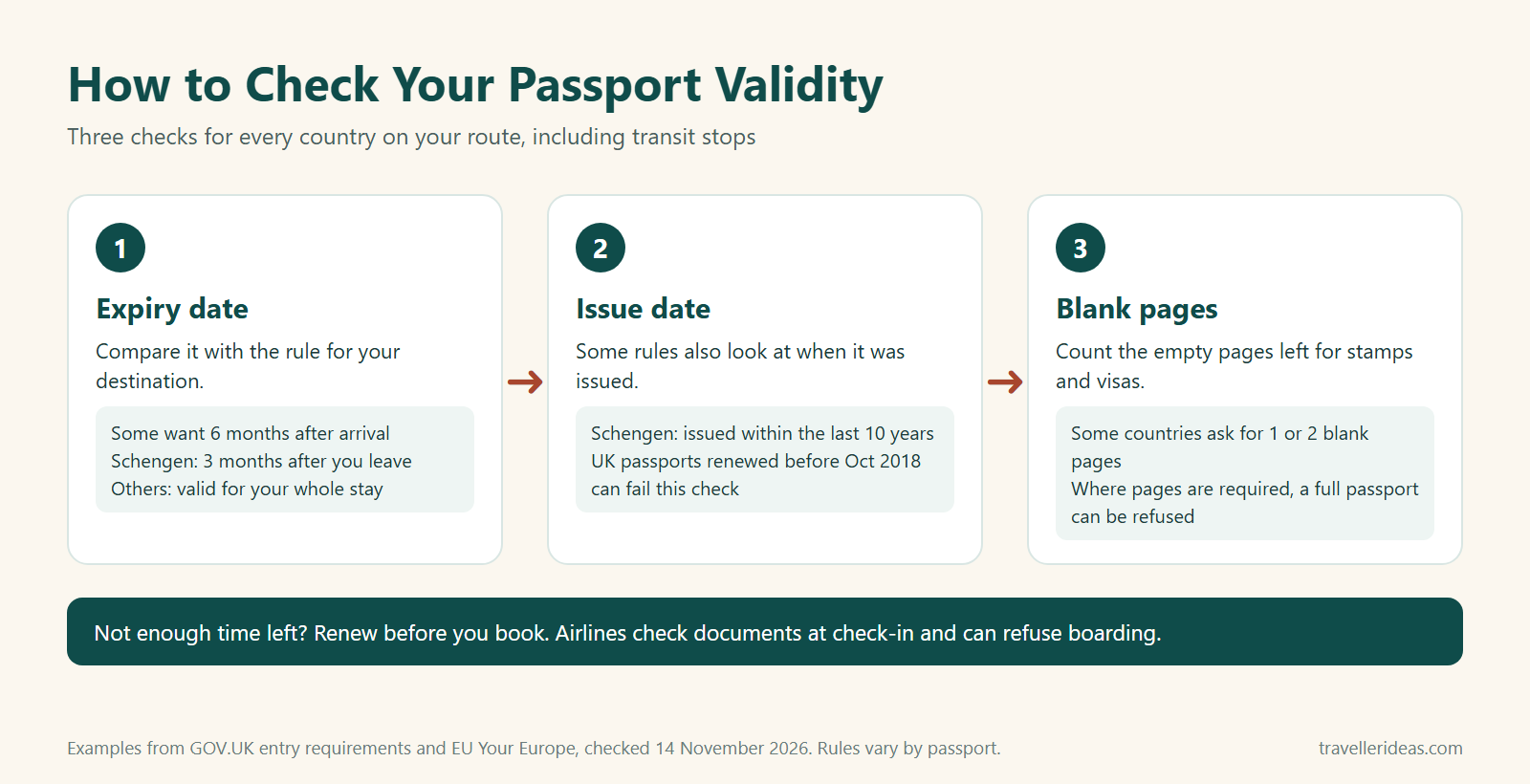
Renewal can take weeks, so build this check into your planning as soon as you pick a destination. Our international travel checklist includes it alongside insurance, money and packing, and the travel packing list covers which documents to carry and copy.
Plan Your Next Trip
Check the rest of your entry and travel prep with these guides:
Passport validity FAQ
What is the 6-month passport rule?
It means your passport must have at least six months of validity left, usually counted from the day you arrive. Not every country uses it: for British passport holders, GOV.UK lists it for places such as the UAE and Thailand, while the USA and Japan only require validity for the length of the stay.
Can I travel if my passport expires in 3 months?
It depends on the destination and your nationality. Some countries only need your passport to be valid for your stay, the Schengen area needs at least 3 months after you leave, and 6-month-rule countries would refuse it, so check each country’s official entry requirements.
Does passport validity count from arrival or departure?
It varies by country. Some rules count from your arrival date, others from the day you leave, and some only need the passport valid until the end of your stay, so read the wording on the official entry page carefully.
How many blank pages do I need in my passport?
Some countries require none, others ask for 1 or 2. For British passport holders, GOV.UK says Thailand requires at least 1 blank page and South Africa at least 2.
Can an airline refuse to let me board because of my passport?
Yes, airlines check travel documents before you fly and can refuse boarding if your passport doesn’t meet the destination’s rules. Many use IATA’s Timatic database for these checks.
What is the Schengen 10-year passport rule?
For non-EU nationals, the passport must have been issued within the last 10 years when you enter, in addition to being valid for at least 3 months after you leave. GOV.UK warns that some British passports renewed before 1 October 2018 may fail this test.
The Bottom Line
Don’t rely on the expiry date alone. Check each country’s rule for months remaining, the issue date and blank pages, count from the right day, and renew early if you’re anywhere near a limit. Five minutes on the official entry requirements page can save you a refused boarding.
Last updated: 14 November 2026. Entry rules change and depend on your nationality, so confirm the current requirements with the official sources linked above and with your airline before you travel.