Money abroad rarely goes wrong in a dramatic way. It leaks: a 3% fee here, a poor exchange rate there, an ATM that charges twice. The best travel money tips are about stopping those small leaks before they add up.
This guide covers how to set up your cards before you go, how to pay and withdraw cash once you’re there, how much cash to carry and when you have to declare it. It’s general information, not personal financial advice, and fees always depend on your own bank and card.
The Quick Answer
Before you go, check what each of your cards charges abroad, pack two cards kept in different places and a little local cash. When you pay or withdraw, always choose the local currency rather than your home currency, use bank ATMs and take out fewer, larger amounts. Carry only the cash you need, and if you’re crossing a border with large sums, check the declaration rules (for example, €10,000 for the EU and more than $10,000 for the US).
On this page
- Travel money tips before you go
- Card, cash or both? Your payment options compared
- Always pay in the local currency
- Using ATMs abroad without paying twice
- How much cash to carry (and when to declare it)
- Keeping your money safe on the road
- After you get home
- Frequently asked questions
- The Bottom Line
Travel money tips before you go
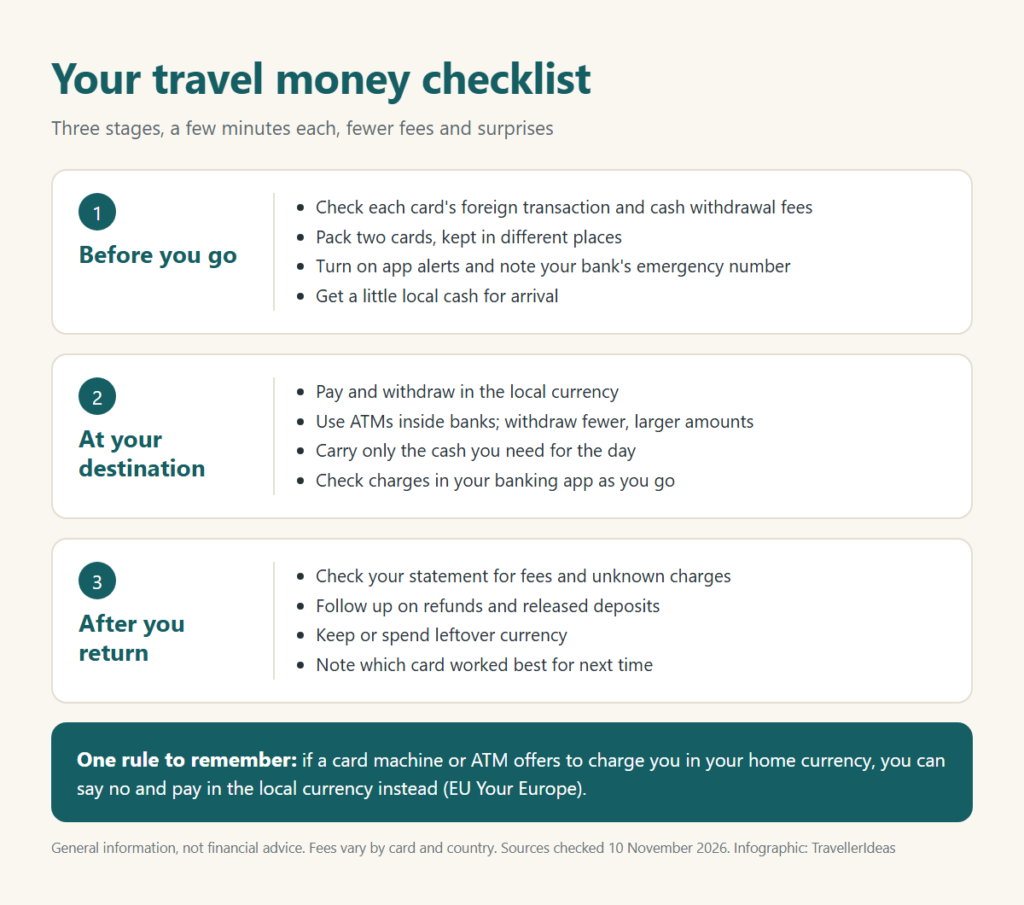
Ten minutes with your banking app before the trip saves more money than any trick at the destination. Money is also one section of our international travel checklist, if you’re working through your pre-trip prep in one go.
- Check the fees on every card you might use. Look for a foreign transaction (or currency conversion) fee on purchases, and separate fees for cash withdrawals. These are listed in your card’s terms or fee schedule.
- Check the card works where you’re going. The US Consumer Financial Protection Bureau, for example, advises prepaid card users to check their cardholder agreement before travelling, because not every card works abroad and some charge foreign transaction fees (CFPB).
- Pack two cards, ideally on different networks, and keep them in different places so one loss doesn’t leave you stuck.
- Turn on app notifications and save your bank’s international phone number somewhere other than your phone.
- Know your PIN. Some machines abroad ask for it even where you’d normally tap or sign at home.
- Get a little local cash for the first taxi, tip or snack, or plan to use an ATM on arrival.
If you’re still setting the overall budget for the trip, start with our guide to budget travel planning, then come back here to decide how you’ll actually pay.
Card, cash or both? Your payment options compared
Most travellers do best with a mix: a card for most spending, a backup card and a small amount of cash. Here’s how the main options compare in general terms. The details depend entirely on your own card’s terms.
| Option | Good for | Watch out for |
|---|---|---|
| Credit card | Hotels, car hire, larger purchases and bookings | Foreign transaction fees; cash withdrawals are often charged as a costly cash advance |
| Debit card | Everyday spending and ATM withdrawals | Per-transaction and withdrawal fees on some accounts; spends your own money directly |
| Prepaid or multi-currency card | Budgeting and holding several currencies | Loading, inactivity or ATM fees; check it works in your destination |
| Cash | Markets, small shops, tips, transport and places that don’t take cards | Loss or theft; poor rates at some exchange counters |
Always pay in the local currency
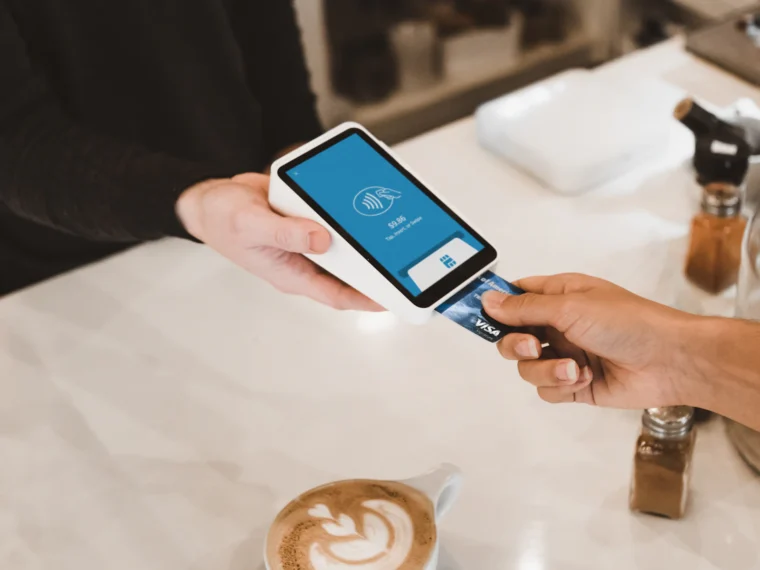
Abroad, a card machine or ATM will often ask whether you want to pay in your home currency. It looks helpful because you see the exact amount in a currency you know. But the exchange rate is then set by the machine’s provider, not your card issuer. This is called dynamic currency conversion, and the rate it uses usually includes a markup.
The simple rule: when asked, choose the local currency, and let your own card handle the conversion. If staff convert the payment for you, you can ask them to run it again in the local currency.
💡 GOOD TO KNOW
In the EU, a shop, website or ATM offering to charge you in your home currency must tell you how much extra it will cost, shown as a percentage markup over the latest European Central Bank exchange rates. You always have the right to say no and pay in the local currency.
Source: European Union, Your Europe: pricing and payments, checked 10 November 2026
Using ATMs abroad without paying twice
A cash withdrawal abroad can carry up to three separate costs: a fee from your own bank, a fee from the ATM’s owner, and the exchange rate applied to the conversion. The European Union’s consumer site lists the first two as separate charges you may pay on top of the amount you withdraw.
- Decline the conversion offer on screen and withdraw in the local currency.
- Read the screen before you confirm. Many machines show the operator’s fee before you accept; if it’s high, cancel and try another bank.
- Take out fewer, larger amounts if your bank charges a flat fee per withdrawal, but only as much as you’re comfortable carrying.
- Use ATMs inside or attached to banks during opening hours. If a card gets stuck, there’s someone to help.
- Avoid using a credit card for cash unless you’ve checked the terms, as many treat it as a cash advance with fees and interest from day one.
How much cash to carry (and when to declare it)
There’s no single right amount. A practical approach is to carry enough cash for a day or two of small purchases (transport, snacks, tips, market stalls), plus a small emergency reserve kept separately, and to top up from ATMs as you go. Ask your accommodation how common card payments are locally; it varies more than you’d expect.
📊 TRAVEL INSIGHT
Even in the euro area, cash is still common. The European Central Bank’s 2024 study of consumer payments found cash was used in 52% of point-of-sale transactions by number, down from 59% in 2022. Cards had the larger share by value, so it’s worth carrying a little of both.
Source: European Central Bank, SPACE 2024 press release, checked 10 November 2026
Carrying large amounts across a border is legal in many places, but you may have to declare it. Two examples from official sources:
- European Union: you must declare €10,000 or more (or the equivalent in other currencies) when entering or leaving the EU. “Cash” includes banknotes, coins, traveller’s cheques and some gold (Your Europe, carrying cash).
- United States: you must report amounts over $10,000 in currency or monetary instruments to US Customs and Border Protection when entering or leaving (CBP, money and other monetary instruments).
💡 GOOD TO KNOW
The EU threshold covers travel into and out of the EU only. There are no EU-wide rules for carrying cash between EU countries, so the EU advises checking with the customs authorities of your departure, arrival and transit countries before you travel.
Source: European Union, Your Europe: carrying cash, checked 10 November 2026

Keeping your money safe on the road
- Split cards and cash between your bag, wallet and accommodation safe.
- Cover the keypad when you enter your PIN, and don’t let your card out of sight when you pay.
- Learn how to freeze a card in your banking app, so you can act in seconds if it goes missing.
- Report a lost or stolen card to your bank straight away, then check recent transactions.
- Count your change, and know roughly what the local notes look like before you arrive.
For wider safety advice before and during a trip, browse our travel safety guides.
After you get home
- Check your statements for fees you didn’t expect and any charges you don’t recognise.
- Make sure hotel and car-hire deposits have been released, and chase any refunds you’re owed.
- Keep leftover notes for your next trip or exchange them; coins are often hard to change back.
- Note which card worked best, and what it actually cost, so next time is easier.
Plan Your Next Trip
Money sorted? Tie up the rest of your planning with these guides.
Frequently asked questions
Is it better to use cash or card abroad?
Usually a mix of both. A card is convenient and avoids carrying large sums, while a little cash covers markets, tips, transport and places that don’t take cards. Check what your card charges abroad before you rely on it.
Should I pay in local currency or my home currency?
Pay in the local currency. If you choose your home currency, the machine’s provider sets the exchange rate, which usually includes a markup. In the EU, you always have the right to refuse the home-currency option.
How can I avoid ATM fees abroad?
Check your own bank’s foreign withdrawal fee before you go, use ATMs run by banks, decline the on-screen conversion offer, and make fewer, larger withdrawals if your bank charges a flat fee each time.
How much cash can I take when travelling?
It depends on the country, and many set a threshold above which you must declare the cash rather than a ban. For example, you must declare €10,000 or more when entering or leaving the EU, and report more than $10,000 when entering or leaving the US. Check the rules for every country on your route.
Should I tell my bank I am travelling abroad?
Check what your bank asks for. Many now rely on fraud monitoring and app alerts rather than travel notices, but turning on notifications and knowing how to contact your bank from abroad helps if a payment is blocked.
The Bottom Line
Check your card fees before you leave, carry two cards and a little cash, and always choose the local currency when a machine asks. Use bank ATMs, keep only what you need on you, and check the declaration rules if you’re crossing a border with a large sum. Small habits like these keep more of your money for the trip itself.
Last updated: 10 November 2026. This is general information, not financial advice. Fees, exchange rates and customs thresholds change and depend on your card and destination; confirm with your bank and the official sources linked above before you travel.