

“Do I need a visa?” is one of the first questions to answer once a trip starts feeling real, and the honest reply is: it depends on your passport, your destination and why you’re going. A friend’s experience, an old forum thread or last year’s trip won’t settle it.
This guide gives you a repeatable six-step method that works for any passport, shows which official sources to trust, and explains what your result (visa-free, eTA, eVisa or visa on arrival) actually means.
The Quick Answer
Whether you need a visa depends on the passport you travel on, where you’re going, why and for how long. Check the destination government’s official rules first, cross-check your own government’s travel advice, then look at every transit stop, passport validity and any travel authorisation (such as the UK ETA or US ESTA). Confirm with your airline before you fly, and re-check close to departure because rules change.
On this page
- Do I need a visa? The four things that decide it
- How to check visa requirements in six steps
- Visa-free, ETA, eVisa or visa on arrival: what your result means
- How to avoid look-alike visa websites
- Frequently asked questions
- The bottom line
Do I need a visa? The four things that decide it
Every country sets its own entry rules, and the same trip can be visa-free for one traveller and visa-required for the person sitting next to them. Four details drive the answer:
- Your passport: the nationality on the passport you’ll travel on, not the country you live in.
- Your destination, plus every country you pass through on the way.
- Your purpose: tourism, visiting family, business meetings, study and paid work are often treated differently.
- Your length of stay and how many times you’ll enter.
Get those four straight before you open a single website, and the official pages become much easier to read. Visas are one line on a longer to-do list, so pair this guide with our international travel checklist for documents, money, packing and safety.
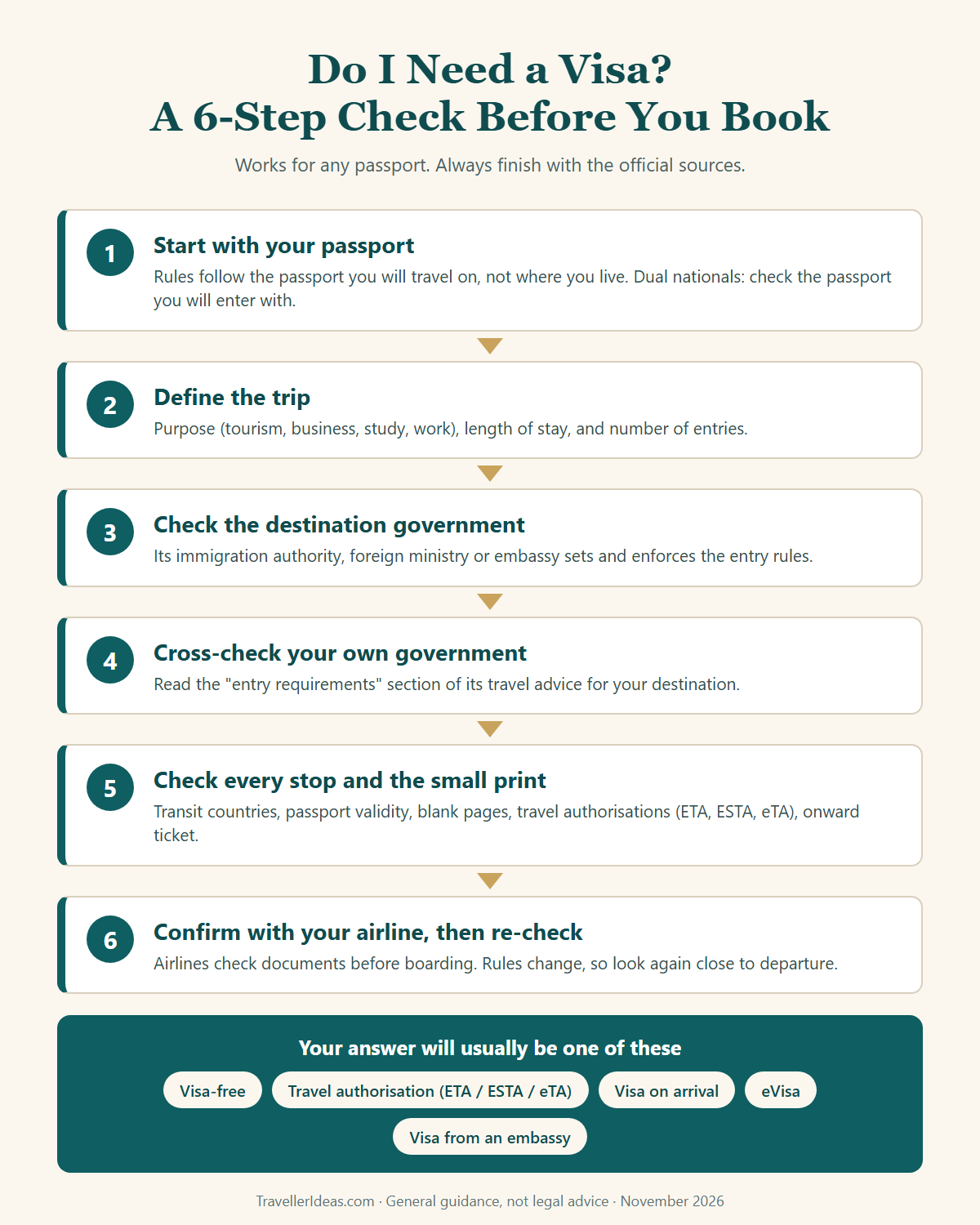
How to check visa requirements in six steps
This method works for any passport and any destination. It takes about as long as choosing a hotel, and it can save you from being turned away at the check-in desk.
1. Start with your passport
Entry rules follow nationality. A long-term resident of one country travelling on another country’s passport is usually assessed on that passport. If you hold two nationalities, check the rules for the passport you plan to enter with, and use the same passport for any online application.
While you have it in your hand, check the expiry date and the number of blank pages. Some countries want validity beyond your stay; others only need it valid for the trip.
2. Pin down the purpose and length of your trip
Visa-free entry is usually for short visits such as tourism or family visits. Paid work, study or a long stay often needs a different permission, even for passports that can walk in as tourists. Write down your dates, purpose and whether you’ll leave and re-enter.
3. Go to the destination’s official source
The destination’s own government decides who gets in, so its immigration authority, foreign ministry or embassy is the primary source. Many publish a nationality-by-nationality list. The UAE Ministry of Foreign Affairs, for example, has a visa exemptions lookup that marks each nationality as visa-free or visa-required. If Dubai is on your list, our Dubai travel guide covers the rest of the planning.
Can’t find a clear answer? Contact the destination’s embassy or consulate in your country. That’s the advice Australia’s Smartraveller gives on its destination pages too.

4. Cross-check your own government’s travel advice
Many governments publish travel advice with an “entry requirements” section for each country, written for their own citizens. It’s a useful second opinion and often flags passport-validity quirks and recent changes.
| If you travel on a… | Official travel advice to cross-check | Where entry rules appear |
|---|---|---|
| British citizen passport | GOV.UK foreign travel advice | “Entry requirements” page for each country |
| Canadian passport | Travel.gc.ca travel advice | “Entry and exit requirements” section for each destination |
| Australian passport | Smartraveller destinations | “Visas and border measures” section for each destination |
| Any other passport | Your own foreign ministry’s travel advice, if it publishes one | Varies; the destination’s embassy remains the final word |
💡 GOOD TO KNOW
Government travel advice is written for one passport. GOV.UK’s entry pages, for example, say the information is for people travelling on a full British citizen passport, and that the destination’s authorities set and enforce the rules. If you hold a different passport, use it as background only.
Source: GOV.UK, Japan entry requirements, checked 9 November 2026
5. Check transit stops and the small print
A connection can need its own paperwork. The UK, for instance, requires an ETA from eligible travellers who pass through border control at a UK airport before continuing their journey. Run every stop on your route through the same check.
Then look for the conditions that sit alongside the visa question:
- Passport validity and blank pages.
- Travel authorisations for visa-exempt visitors, such as the UK ETA, US ESTA or Canada eTA.
- Proof of an onward or return ticket, accommodation or funds, where the destination asks for them.
- Arrival cards or pre-registration forms.
6. Confirm with your airline, then re-check
Airlines check your documents before you board, and if they don’t match the entry rules, you can be refused boarding. Check your airline’s travel-document guidance once you’ve booked, and look at the official rules again in the final week or two before departure.

📊 TRAVEL INSIGHT
IATA’s Timatic database, used by airlines and travel agents, checks the travel documents of over 700 million passengers a year. IATA says it handles up to 200 rule changes and updates a day, which is why a check you did months ago may already be out of date.
Source: IATA, Timatic, checked 9 November 2026
Visa-free, ETA, eVisa or visa on arrival: what your result means
Once you’ve checked, your answer usually lands in one of five buckets. The names vary by country, so read the destination’s own wording carefully.
| Result | What it means | When you sort it out |
|---|---|---|
| Visa-free | You can enter for a short stay with your passport alone, subject to the usual entry conditions. | Nothing to apply for, but check validity and conditions. |
| Travel authorisation (e.g. UK ETA, US ESTA) | An online pre-clearance for visa-exempt visitors. It is not a visa and doesn’t guarantee entry. | Online, before you travel. |
| eVisa | A visa you apply for and receive online. | Before you travel; allow processing time. |
| Visa on arrival | Issued at the border for eligible nationalities, sometimes with a fee and conditions. | On arrival, if you’re eligible. |
| Embassy or consulate visa | A full application, often with documents, appointments and biometrics. | Well before travel, often weeks ahead. |
A travel authorisation is still a requirement, not a formality. The US Visa Waiver Program lets citizens of 42 countries visit for up to 90 days without a visa, but they need an approved ESTA, and CBP notes that an ESTA doesn’t decide whether you’ll be admitted. Officers make that call at the border.
💡 GOOD TO KNOW
Europe’s ETIAS travel authorisation is not in operation yet, and the EU says no applications are being collected. When it launches, it will cost EUR 20 and the EU will announce the start date several months ahead. Until then, any site taking ETIAS “applications” is not the official one.
Source: European Union, What is ETIAS, checked 9 November 2026
How to avoid look-alike visa websites
Search results for visas are crowded with private agents. Some are legitimate services that charge for help; others imitate government sites. A few habits keep you on the official path:
- Reach application pages through the government’s main website, not an ad.
- Check the web address carefully: official portals usually sit on government domains.
- Compare the fee with the one the government publishes before you pay.
- Treat third-party “visa checker” tools as a first pass, then confirm on the official page.
💡 GOOD TO KNOW
The UK government states that an ETA costs £20 and warns that other websites may charge more to apply. It’s a good reminder to check the official fee on any authorisation before you pay.
Source: GOV.UK, Apply for an electronic travel authorisation (ETA), checked 9 November 2026
Plan Your Next Trip
Visa question answered? Line up the rest of your paperwork and plans with these guides.
Frequently asked questions
How do I know if I need a visa for a country?
Check the destination government’s official immigration or foreign ministry website using the passport you will travel on. Then cross-check your own government’s travel advice for that country, check any transit stops, and confirm with your airline before you fly.
Do I need a visa if I am only transiting through a country?
Sometimes, yes. Some countries require a transit visa or travel authorisation even for a connection. The UK, for example, requires an ETA from eligible travellers who pass through border control at a UK airport. Check each transit country with its official source and your airline.
Is an ETA or ESTA the same as a visa?
No. A travel authorisation such as the UK ETA or US ESTA is an online pre-clearance for visitors who don’t need a visa. It is still mandatory if it applies to you, and it doesn’t guarantee entry: border officers make the final decision.
Does my country of residence affect whether I need a visa?
Usually the passport you travel on is what counts, not where you live. If you hold a residence permit or visa from another country, check whether the destination’s official rules mention it before assuming it changes anything.
How far in advance should I check visa requirements?
Check before you book flights or accommodation, then check again shortly before you travel. Some visas take weeks to process, and entry rules can change at short notice.
The Bottom Line
You can’t answer “do I need a visa?” from a general list. Start with your passport, check the destination’s official rules, cross-check your government’s advice and every transit stop, and confirm with your airline. Then check once more before you fly.
Last updated: 9 November 2026. This guide covers general methods for any passport, not rules for a specific nationality, and it isn’t legal advice. Entry rules change often, so confirm with the official sources linked above and with your airline before you travel.