
A foreign transaction fee is easy to miss: a small percentage added to every card payment or withdrawal abroad, often buried in your statement. Over a trip it can add up to a noticeable sum. The good news is that it’s one of the easiest travel costs to cut, and you can learn how to avoid foreign transaction fees in a few minutes before you go.
This is general consumer information, not financial advice, and it doesn’t recommend specific cards. Regulatory details refer to US rules (CFPB) and EU rules; check your own card’s terms and your country’s consumer rules.
The Quick Answer
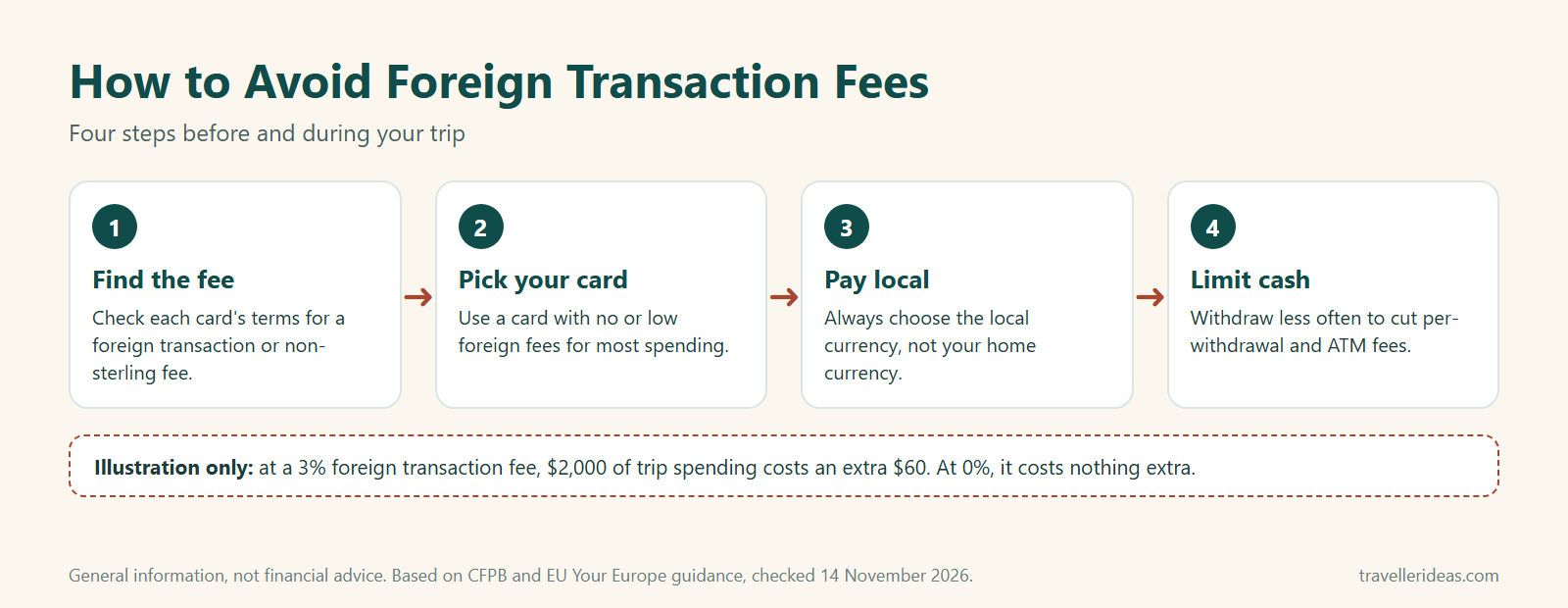
To avoid foreign transaction fees, check your card’s terms for a foreign transaction (or non-sterling) fee before you travel, and use a card that charges no or low foreign fees for most spending. Always pay in the local currency rather than your home currency, take cash out less often, and remember that buying online from a foreign merchant can trigger the same fee even at home.
On this page
- What is a foreign transaction fee?
- How much it can cost
- How to avoid foreign transaction fees
- Fees that look similar
- If you live in the EU
- Foreign transaction fees FAQ
- The bottom line
What is a foreign transaction fee?
Different banks use different names for it. In the UK it’s often called a non-sterling transaction fee, and some providers call it a currency conversion fee.
💡 GOOD TO KNOW
The US Consumer Financial Protection Bureau describes a foreign transaction fee as one your card provider charges when you use your card in a foreign country or to pay in a foreign currency. It says the fee is usually a percentage of the purchase, withdrawal or other transaction rather than a flat fee, and is also called a currency conversion fee.
Source: CFPB, prepaid card key terms, checked 14 November 2026
One catch surprises people: the fee isn’t only for trips. Under US credit card disclosure rules, the CFPB’s official interpretation says the foreign transaction fee includes charges for purchases in a foreign currency or with a foreign merchant, so booking a hotel or tour directly with an overseas company online can trigger it even if you’re at home.
How much it can cost
Because the fee is usually a percentage, it scales with your spending. The figures below are a generic illustration, not a quote; your card’s actual fee is in its terms.
| Trip spending on card (illustration) | At 0% fee | At 1% fee | At 3% fee |
|---|---|---|---|
| $500 | $0 | $5 | $15 |
| $2,000 | $0 | $20 | $60 |
| $5,000 | $0 | $50 | $150 |
That’s before any ATM charges or a poor exchange rate from paying in your home currency, which can stack on top.
How to avoid foreign transaction fees
- Find the fee in your card’s terms. In the US, credit card issuers generally have to show foreign transaction fees in the summary table of card terms, so look there first. For debit and prepaid cards, check the fee schedule or cardholder agreement.
- Use a card with no or low foreign fees for most of your spending, and keep a second card as backup.
- Always choose the local currency when a card machine, ATM or website offers your home currency.
- Withdraw cash less often, in larger amounts, so per-withdrawal fees bite less.
- Check prepaid cards carefully. The CFPB notes some charge foreign transaction fees and not all work abroad.
- Watch overseas online bookings, which can attract the fee even when you’re at home.
💡 GOOD TO KNOW
The CFPB’s official interpretation of US credit card rules says the foreign transaction fee includes charges for purchases and cash advances made in a foreign currency, outside the US, or with a foreign merchant. These fees are generally disclosed in the table of key terms in a card application.
Source: CFPB, Regulation Z § 1026.60 and official interpretation, checked 14 November 2026
Fees that look similar
Avoiding the foreign transaction fee doesn’t mean avoiding every cost. Watch for these too:
- ATM operator fees, charged by the machine’s owner on top of anything your bank charges.
- Cash withdrawal fees from your own bank, often a flat fee, a percentage or both.
- Cash advance charges on credit cards used at ATMs, which can include extra fees and interest.
- Dynamic currency conversion, where the shop or ATM converts for you at its own rate.
For a fuller picture of paying, cash and ATMs abroad, see our travel money tips guide.
If you live in the EU
EU residents have extra protection when travelling within the EU, especially in the euro area.
💡 GOOD TO KNOW
EU rules say your bank must charge the same for euro payments and euro ATM withdrawals anywhere in the EU as for equivalent transactions at home. When you pay in a non-euro EU currency you may still be charged a currency conversion fee, but your provider must tell you the amount of any such fee.
Source: EU Your Europe, payments and transfers, checked 14 November 2026
The EU also gives you the right to refuse a home-currency conversion at shops and websites and pay in the local currency. Our guide on the budget travel planning side of a trip helps you set a realistic spending plan once fees are under control.
Plan Your Next Trip
Keep more of your travel money with these guides:
Foreign transaction fees FAQ
What is a foreign transaction fee?
It’s a fee your card provider charges when you use your card abroad or pay in a foreign currency. It’s usually a percentage of each transaction rather than a flat fee, and may also be called a currency conversion or non-sterling transaction fee.
How do I avoid foreign transaction fees?
Check your card’s terms before you travel and use a card with no or low foreign fees for most spending. Always choose to pay in the local currency and withdraw cash less often to limit other charges.
Do foreign transaction fees apply to online purchases?
They can. Under US credit card rules, the fee can apply to purchases made with a foreign merchant, so booking directly with an overseas company online may trigger it even if you pay from home.
Is a foreign transaction fee the same as an ATM fee?
No. The foreign transaction fee is charged by your card provider on foreign transactions, while ATM fees can come from both your bank and the machine’s operator. You can be charged both on one withdrawal.
Should I pay in my home currency to avoid fees?
Usually not. Paying in your home currency lets the shop or ATM convert at its own rate, which is often worse; in the EU you have the right to refuse and pay in the local currency.
Do EU residents pay foreign transaction fees in the EU?
For euro payments and euro ATM withdrawals in the EU, EU rules say your bank must charge the same as for domestic transactions. Payments in non-euro currencies may still carry a currency conversion fee, which must be disclosed.
The Bottom Line
Foreign transaction fees are a percentage on every foreign payment, so they’re worth five minutes before a trip. Check your cards’ terms, use one with no or low foreign fees, always pay in the local currency and limit cash withdrawals, and you’ll keep that money for the trip itself.
Last updated: 14 November 2026. This is general information, not financial advice. Fees vary by card and provider, so confirm the details with your card issuer and the official sources linked above before you travel.